
Factory Radio Versus Bluetooth Retrofit
If you have ever tried to take a call, stream music, or hear directions through a stock Squarebody stereo, you already know the problem. The factory radio versus Bluetooth retrofit question is not really about chasing new tech for the sake of it. It is about whether your truck still works the way you actually use it.
For a 1973-1991 Chevy or GMC truck, Blazer, Jimmy, or Suburban, audio upgrades are never just about sound quality. They touch wiring, dash appearance, speaker placement, charging, and how much you care about keeping the truck period-correct. Some owners want the original knobs and faceplate because that is part of the truck's identity. Others just want to stop messing with FM transmitters and cassette adapters that sound like a blown drive-in speaker.
There is no one-size-fits-all answer here. A clean survivor, a weekend trail rig, and a daily-driven long bed all have different priorities. That is why the right choice depends on how you use the truck, how original you want to keep it, and how much work you are willing to do behind the dash.
Factory radio versus Bluetooth retrofit in a Squarebody
The stock factory radio still has one big advantage - it belongs there. The look is right, the dash stays true to the era, and if you are restoring a truck with a strong original interior, keeping that radio can make sense. For owners who care about factory appearance above all else, that matters more than people like to admit.
But the downside shows up fast once the truck leaves the garage. Most original units lack power, clarity, and any practical way to connect a phone. Even when the radio still works, it is working with old electronics, limited output, and often speakers that were never impressive to begin with. If your truck sees regular road time, especially with mud tires, exhaust, or wind noise, a stock radio can feel more like a decoration than a usable stereo.
A Bluetooth retrofit flips that equation. You gain phone connectivity, streaming, hands-free calling in some setups, and usually better audio performance. You also get a truck that is easier to live with every day. The trade-off is that not every retrofit looks right, and not every kit is built with Squarebody fitment in mind.
When keeping the factory radio still makes sense
If your truck is a highly original build, a factory radio can still be the right move. That is especially true for show trucks, low-mile survivors, or builds where the goal is to preserve the cabin's original feel. In those cases, the radio is part of the overall package, just like the gauge cluster, steering wheel, and bench seat upholstery.
Some owners also use their trucks in a way that makes modern audio less important. Maybe the truck only comes out for short drives, local shows, or cruise nights. Maybe hearing the small block, the transfer case, and the tires is part of the whole point. If that sounds like your truck, forcing a modern stereo into the dash may solve a problem you do not really have.
There is also a middle ground. Some owners keep the factory radio for appearance and hide modern audio components elsewhere. That route can work, but it usually adds complexity. You are now balancing stock looks with hidden modules, separate controls, or extra wiring that still needs a clean install. It can be done well, but it is not always the simple option people expect.
When a Bluetooth retrofit is the better real-world choice
If you actually drive your Squarebody a lot, Bluetooth usually wins. It is hard to argue against being able to jump in, start the truck, and have your music or podcast connect without messing around. If you use your truck for commuting, road trips, trail runs, or even parts-store duty, modern connectivity is more than a convenience. It is part of making an old truck work in the current world.
Bluetooth retrofits also make more sense once you have upgraded the rest of the interior. Better door speakers, improved speaker panels, cleaner wiring, and usable cup holders all point toward the same goal - making the cabin more functional without losing what makes the truck a Squarebody. A modern head unit or retrofit module fits that same mindset when it is done cleanly.
The biggest advantage is usability. You get easier control over what you listen to, better source options, and usually stronger output. That matters in a truck with road noise and age-related interior rattles. A weak factory radio trying to push old speakers is fighting a losing battle before you even leave the driveway.
Sound quality is not just about the radio
A lot of guys blame the radio when the real issue is the whole system. In a Squarebody, the head unit is only one part of the equation. Old speakers, tired wiring, poor grounds, and limited speaker placement all drag the system down.
So if you are weighing factory radio versus Bluetooth retrofit strictly on sound, be honest about the rest of the truck. A Bluetooth-capable unit feeding decent speakers through solid wiring will almost always outperform a stock setup. But dropping in a new radio while leaving crusty old speakers and questionable wiring in place may not deliver the jump you expected.
This is where platform-specific interior upgrades matter. Speaker placement and fitment in these trucks can be awkward, especially if you are trying to avoid cutting up good panels or forcing universal parts where they do not belong. A clean install with the right speaker solution usually makes a bigger difference than chasing brand names on the box.
Wiring, fitment, and dash appearance
This is where the decision gets real. Plenty of Bluetooth options look fine in a product photo and terrible in an actual Squarebody dash. Wrong face shape, weird lighting, cheap trim, poor knob feel - all of that stands out fast in a truck with a simple, classic interior.
A factory radio avoids that problem completely, but you give up convenience. A full aftermarket head unit gives you modern features, but you need to think about how it fits the dash opening, what trimming is required, and whether the final look still feels right in the truck.
Retrofit-style units split the difference. Some are designed to keep a more classic appearance while adding Bluetooth and newer internals. Those can be a strong option for owners who want modern function without a flashy modern stereo face. The catch is price. The cleaner and more period-friendly the setup looks, the more you usually pay.
Wiring also matters more than most people want to hear. Old truck wiring has a way of exposing shortcuts. Bad grounds, hacked previous installs, and mystery splices can turn a simple radio swap into an afternoon of chasing electrical problems. If the truck has seen decades of owners, plan for some cleanup behind the dash no matter which direction you go.
Cost depends on what problem you are solving
If your goal is just to keep the truck original and hear AM or FM once in a while, keeping the factory radio is obviously cheaper. If the unit still works, the cost is basically zero. Even a repair or refurbish can be reasonable if originality is the main target.
If your goal is daily convenience, the math changes. A Bluetooth retrofit may cost more upfront, but it often solves multiple problems at once. Better connectivity, stronger output, and cleaner phone integration all add up to a truck you enjoy driving more often.
What gets expensive is trying to cut corners. Cheap universal stereos, sloppy wiring adapters, and random speaker choices can leave you spending money twice. For Squarebody owners, the smarter buy is usually the one that fits the truck right the first time and does what you actually need.
So which one should you choose?
If your Squarebody is mostly a preservation piece, the factory radio still has a solid case. It keeps the dash honest, protects the truck's original look, and makes sense for owners who are not asking much from the stereo.
If your truck gets used like a truck, a Bluetooth retrofit is usually the better answer. It makes the cabin easier to live with, gives you modern audio where you need it, and helps an old platform keep up without pretending it is something it is not.
The best setups are the ones that match the build. A workhorse does not need concours-correct audio. A survivor does not need a glowing touchscreen that looks out of place. Build around how the truck gets used, not around what sounds good on a forum thread.
A Squarebody should still feel like a Squarebody when you turn the key. The trick is deciding whether that means hearing the original radio crackle to life, or hearing your playlist start the second the engine settles into idle.
Shop the Part
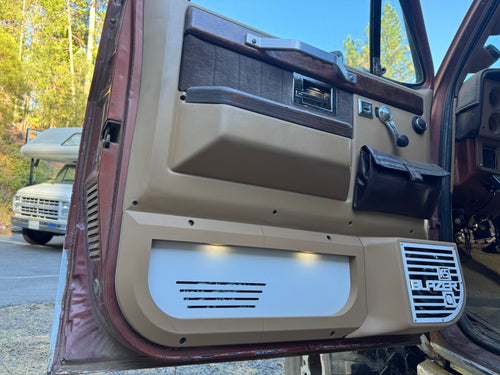
Whichever way you go on the head unit, a no-cut door speaker panel keeps the upgrade clean and reversible: Customizable Front Door Speaker Panels — '73–'91 Squarebody Chevy & GMC
Need The Parts For This Build?
We carry everything mentioned in this guide — picked and backed by real Squarebody owners.
0 Comments
Leave a Comment