
Will All Squarebody Parts Fit a K5 Blazer?
Quick Takeaways
- The K5 is a shortened half-ton pickup, so front-clip, front suspension, and drivetrain parts often interchange. The back half is K5-specific — rear sheet metal, quarter panels, cargo trim, and the tailgate don't swap with a pickup. Interchange is closest within 1981–1986, workable across 1981–1991, and slimmer across the full 1973–1991 span. Don't trust "fits all Squarebodies" listings — confirm year, body style, 2WD/4WD, and half-ton vs heavy-duty. "Fits" often means "can be made to fit" — know if you're buying a bolt-on or a fabrication starting point.
If you've ever stood in the garage holding a pickup part next to your K5 wondering if you can make it work, you're asking the same thing every Squarebody owner asks eventually — will this part fit, or are you about to waste time and money? The honest answer is that plenty of parts swap over and plenty don't, and the difference usually comes down to wheelbase, body style, mounting points, and how the truck was actually built from the factory.
That matters because "Squarebody" is a wide umbrella. A 1973–1991 Chevy or GMC pickup, Suburban, Jimmy, and K5 Blazer share the same basic design language, but they aren't all the same truck. The K5 is essentially a shortened version of the half-ton pickup — which tells you a lot about where parts cross over and where they don't. Buy based on the body lines alone and you can get burned fast.
Sometimes Yes, Sometimes No
The trick is knowing which categories of parts were shared across the platform and which were unique to the K5.
A K5 Blazer shares a lot with short-bed pickups of the same generation, especially up front. Many front-end parts, engine-related parts, some chassis parts, and a good chunk of interior hardware can interchange depending on year range. But once you move rearward, the K5 becomes its own animal. The removable top, different quarter panels, shorter wheelbase, rear floor layout, and cargo area all create fitment differences that matter. And if you're shopping upgrades instead of factory replacement parts, the same rule applies — parts built around pickup dimensions don't always land right on a K5, even when the seller throws "Squarebody" in the listing.
Where K5 Blazers Usually Share Parts
The front clip is where interchange is strongest. Fenders, many hood components, core-support-related pieces, grille-area hardware, and some bumper setups can cross over when the years line up. Front suspension components also overlap heavily, especially within the same drivetrain and axle family. There's an old junkyard rule among K5 owners: if it has the same front end, it'll usually fit up front.
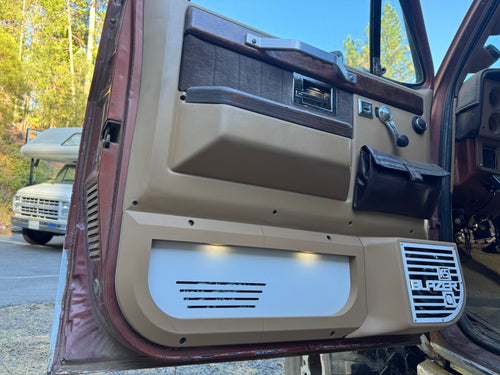
Interior fitment is often better than people expect too. Dash components, switches, steering columns, gauge-related parts, and some seating hardware frequently share enough to swap. This is exactly why platform-specific interior upgrades matter — the details are rarely universal, but they're often close enough that a part designed around Squarebody mounting locations solves a real problem instead of creating a new one. Doors are another area where people assume everything matches, and they're often close. Door shell and internal components can interchange depending on year, trim, and power-versus-manual setups, but door panels, speaker solutions, and trim-specific pieces can change enough to need a K5-specific check before you order.
Drivetrain parts are usually less about K5-versus-pickup and more about year, transmission, transfer case, engine family, emissions setup, and whether you're dealing with half-ton or three-quarter-ton running gear. If the truck shares the same mechanical package, many parts transfer without drama.
Where They Usually Don't Fit
The back half of the truck is where most bad assumptions happen. Beds obviously don't apply, but the bigger issue is people buying rear body and interior parts marketed for "1973–1987 C10/K10" and expecting them to bolt into a K5. A K5 has different rear sheet metal, different floor geometry, different interior side panels, and a totally different use case.
Quarter panels are K5-specific. Rear bumpers can be different. Cargo-area panels and trim are different. Tailgate parts need special attention because the K5's rear glass retracts into the tailgate as one unit — a setup that's not the same as a pickup's rear end and is known for worn crank gears and failing window motors. Even simple weatherstripping turns into a headache if the listing is vague. Frame assumptions can bite you too: wheelbase and body-mount differences mean a part designed around a pickup frame length or rear body mount may not fit your K5 without modification. Not a dealbreaker if you fabricate, but a problem if you expected a clean bolt-on.
Year Ranges Matter More Than People Think
One of the biggest mistakes in Squarebody fitment is treating 1973–1991 as one giant interchangeable pile. It isn't.
Front-end styling changed. Interior details changed. Steering columns, wiring, emissions, and drivetrain hardware all changed. As a rough guide, direct-fit interchange is closest within the 1981–1986 trucks, still workable across 1981–1991, and gets slimmer the wider you stretch toward the full 1973–1991 span. The early trucks add another wrinkle: 1973–1975 K5s used a full removable convertible top, and the half-cab design didn't arrive until 1976. So when someone says "it fits Squarebodies," your next question should be "which years, which body style, and which trim or drivetrain setup?" That question saves money.
Interior Upgrades Are Where Fitment Has to Be Honest
This is where generic aftermarket parts usually miss. A universal console, cup holder, or speaker panel might technically fit inside a K5, but that doesn't mean it fits well, clears what it should, or looks right in a truck you actually use.
Squarebody interiors have their own quirks — bench seats, floor shifters, transfer case levers, seat travel, and door panel layouts all affect what works. A K5 adds its own considerations because many owners use them harder than a street-only pickup. If you wheel the truck, haul gear, or climb in and out with muddy boots, a loose universal accessory gets old fast. That's why platform-specific parts make sense: they solve the real problems — poor storage, no usable cup holders, weak speaker locations, awkward console height — without making you trim half the truck or live with a shaky install. Blazin' Biddles Offroad builds its interior parts specifically around 1981–1991 K5 Blazers, Jimmys, and Suburbans for exactly that reason. If you're weighing what actually works in these cabs, start with the best Squarebody center console upgrades that fit.
How to Tell If a Part Will Fit Your K5
Start with the body style, not the brand name in the listing. A seller can say Chevy, GMC, Squarebody, C10, K10, Blazer, Jimmy, and Suburban all in one sentence, and that doesn't mean the part was designed around your truck.
Check the year range first. Then confirm whether the part is for a pickup, K5 Blazer/Jimmy, or Suburban. After that, look at the variables that change fitment: 2WD versus 4WD, half-ton versus heavy-duty, manual versus power accessories, and factory versus modified mounting points. Photos help, but measurements help more — if it mounts in the cab, under the dash, on the doors, or around the rear cargo area, compare the mounting style and dimensions before you commit. If the seller only gives broad language and no real fitment details, that's a red flag. And be honest about your own truck: 40-year-old rigs rarely stay stock, and body lifts, aftermarket seats, cage work, custom stereos, swapped axles, and patched sheet metal can all change whether an otherwise correct part still fits.
Bolt-On Versus "Can Be Made to Fit"
This is where a lot of frustration comes from. In the Squarebody world, people often say a part fits when they really mean it can be drilled, trimmed, spaced, welded, or persuaded into place.
That may be fine if you're building a trail truck and fabrication is part of the plan. It's not fine if you're ordering what you think is a direct-fit replacement for a daily-driven K5. There's nothing wrong with modifying parts — most of us have done it. But you should know before you buy whether you're getting a bolt-on part or a starting point. Those are two different products, even if the listing doesn't say so.
The Smart Answer for K5 Owners
So, will all Squarebody parts fit a K5 Blazer? No — but a lot of them will, especially in the front clip, drivetrain, and shared interior areas. The ones that won't are mostly the rear body sections, cargo-area parts, tailgate components, and anything designed around pickup-specific dimensions.
The safest move is to treat your K5 like what it is — part of the Squarebody family, but not just a pickup with a removable top. When you buy parts actually designed with that in mind, installs go smoother, the truck works better, and you spend more time driving it instead of reboxing the wrong stuff. If a parts seller can't tell you exactly why it fits your K5, keep looking. Your truck deserves better than "close enough."
Frequently Asked Questions
Do pickup parts fit a K5 Blazer?
Many front-end, front suspension, drivetrain, and shared interior parts do, because the K5 is essentially a shortened half-ton pickup. Where it breaks down is the back half — rear sheet metal, quarter panels, cargo-area trim, and the tailgate are K5-specific and won't interchange with a pickup's rear end.
What years of Squarebody parts interchange best with a K5?
Direct-fit interchange is closest within the 1981–1986 range, still workable across 1981–1991, and gets slimmer the wider you stretch toward the full 1973–1991 span. Front-end styling, interior, wiring, and drivetrain all changed over the years, so always confirm the specific year range for the part.
Will interior upgrades made for Squarebody pickups fit my K5?
Often the front cab area shares enough to work, since dashes, columns, and console areas overlap. But "technically fits" isn't the same as fits well. Confirm the part is built for K5/Jimmy applications and your year range. Blazin' Biddles interior parts are built specifically for 1981–1991 Blazers, Jimmys, and Suburbans.
Why don't rear body parts interchange between a K5 and a pickup?
The K5 has a shorter wheelbase, different rear sheet metal and floor geometry, K5-specific quarter panels, and a unique tailgate where the rear glass retracts into the gate. Pickups have a bed and a completely different rear structure. Rear parts marketed for C10/K10 pickups won't bolt into a Blazer.
How do I know if a part is a true bolt-on for my K5?
Check the year range, confirm it's specified for K5 Blazer/Jimmy, and look at 2WD versus 4WD and half-ton versus heavy-duty. Compare mounting style and real measurements, not just photos. If the seller only offers vague "fits all Squarebodies" language with no specifics, treat it as a starting point that may need fabrication, not a guaranteed bolt-on.
Need The Parts For This Build?
We carry everything mentioned in this guide — picked and backed by real Squarebody owners.
0 Comments
Leave a Comment