Squarebody C/K vs R/V: What's the Difference?
Quick Takeaways
- C/K and R/V are the same Squarebody body — GM renamed C/K to R/V in 1987 to free the name for the new GMT400. R = 2WD, V = 4WD, shown in the 5th VIN digit; the change was naming and drivetrain, not a different truck. R/V ran 1987–1991 on the trucks that kept the old body: K5 Blazer, Jimmy, Suburban, crew cabs, and HD models. In 1988–1991 a "K1500" is a GMT400 (new body), not a Squarebody — same year, completely different truck. A 1990 Suburban part won't fit a 1990 pickup; confirm you're matching R/V to R/V, not R/V to GMT400.
If you've ever shopped parts for a late Squarebody and run into the letters "R" and "V" where you expected "C" and "K," you've hit one of the most confusing wrinkles in these trucks. People assume R/V is some different truck, or a different body, or a heavy-duty-only thing. It's not. Understanding what actually changed saves you from buying the wrong part for a 1988–1991 truck — which is exactly where this trips people up.
Here's the short version: C/K and R/V are the same body. The letters changed, the truck didn't. But which trucks wear which letters, and in which years, is where the real fitment lesson lives.
What C/K Means
For the 1973–1987 run, every full-size GM truck used the C/K designation. C meant two-wheel drive, K meant four-wheel drive. That covered pickups, K5 Blazers, Jimmys, and Suburbans. Tonnage rode alongside the letter: 10 for half-ton, 20 for three-quarter-ton, 30 for one-ton. So a C10 is a 2WD half-ton, a K20 is a 4WD three-quarter-ton, and so on. This is the naming most people mean when they say "Squarebody" — and it's the naming on the badges through 1987.
Why GM Changed It to R/V
For 1987, GM renamed the Rounded-Line C/K trucks — what we call Squarebodies — to the R/V series. R took over for two-wheel drive, V for four-wheel drive. You'll find the change in the fifth digit of the VIN.
The reason was simple: GM had an all-new truck coming. The GMT400 (the trucks enthusiasts now call OBS) launched in April 1987 as a 1988 model, and GM wanted to reuse the "C/K" name for it. You can't sell two different trucks called C/K at the same time, so the old body got renamed R/V and the new body took C/K. For a few years, GM built both lines side by side. Same idea as the model codes: the new GMT400 trucks used C/K with 1500/2500/3500 tonnage, while the old-body R/V trucks used R/V with their own numbering. That overlap is the whole source of the confusion.
The Part Everyone Gets Wrong
Here's the trap. When the GMT400 arrived, the Squarebody body didn't disappear — it kept going under the R/V name, but only for certain trucks. Half-ton Squarebodies were dropped after 1987. Three-quarter-ton continued through 1990. One-ton trucks, crew cabs, and the full-size SUVs — the K5 Blazer, Jimmy, and Suburban — kept the Squarebody body all the way through 1991.
So in 1988 through 1991, you had two completely different trucks sharing showroom space: the new GMT400 pickups (badged C/K, 1500/2500/3500) and the old-body R/V trucks (the SUVs, crew cabs, and heavier-duty rigs). A "K1500" from these years is a GMT400 — a totally different truck. A "V3500" or a 1990 Suburban is the Squarebody body you actually want parts for. This is why an owner shopping for a 1990 Suburban part gets burned assuming a 1990 pickup part will fit. Same year, completely different trucks.
Is an R/V Truck Still a Squarebody?
Yes. An R/V-series Blazer, Jimmy, Suburban, crew cab, or dually is the same Rounded-Line body as a 1973–1987 C/K. The sheet metal, cab, doors, and general layout are Squarebody through and through. R/V is just the name GM used from 1987 on to keep the old body separate from the new GMT400. Enthusiasts still call all of them Squarebodies, and for good reason — they are.
That means for a lot of parts, an R/V truck takes the same components as the earlier C/K trucks, especially in the areas that didn't change. The trick is knowing what did change over the years, which is where fitment homework matters.
What Actually Changed in the Late Years
The R/V trucks weren't frozen in time. A few real changes matter when you're buying parts:
- Fuel injection: TBI (throttle body injection) came in for 1987, replacing carburetors on most engines. That changes intake, fuel delivery, and wiring compared to an earlier carbureted truck.
- The 1988 antenna: the windshield-integrated antenna used since 1973 was replaced with a fender-mounted antenna. Small thing, but a visible tell for the year.
- The 1989 facelift: the SUVs and crew cabs got a new grille treatment meant to echo the newer GMT400 look, plus a 4-spoke steering wheel. So a 1989–1991 Blazer or Suburban looks a little different up front than an early-'80s truck, even though it's the same body underneath.
- Axles and drivetrain: late trucks saw running changes to axle shafts and accessory drives. Not a dealbreaker, but worth confirming on drivetrain parts.
None of that changes the fact that it's a Squarebody. It just means "1973–1991" isn't one interchangeable pile — the year and the specific truck still decide what fits.
How This Affects Buying Parts
The practical takeaway is short. If you've got a 1988–1991 truck, know whether it's an R/V (old Squarebody body — Blazer, Jimmy, Suburban, crew cab, HD) or a GMT400 (new body — the C/K 1500/2500/3500 pickups). They share almost nothing body-wise despite the overlapping years. When you're ordering, tell the seller you have an R/V truck, not a same-year pickup, so you don't end up with GMT400 parts that won't fit your Squarebody body.
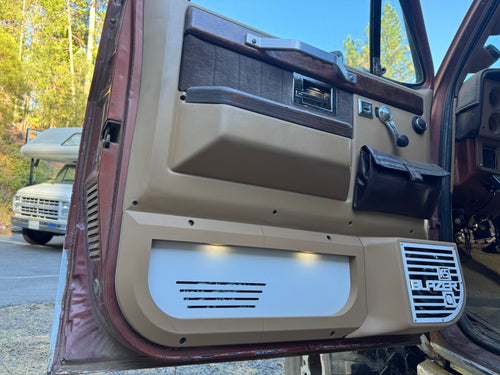
This is exactly the kind of detail that makes platform-specific parts matter. Interior upgrades built for the Squarebody cab fit the R/V SUVs the same as the earlier trucks, because the cab is the same — Blazin' Biddles Offroad interior parts are built for 1981–1991 K5 Blazers, Jimmys, and Suburbans, which covers the R/V years. If you want the full method for confirming any part against your specific truck, it's in how to know what fits your Squarebody.
The Bottom Line
C/K and R/V are the same Squarebody body wearing two different names. C/K covers 1973–1987 (and got reused for the unrelated GMT400 in 1988). R/V covers 1987–1991 on the trucks that kept the old body — the K5 Blazer, Jimmy, Suburban, crew cabs, and heavier-duty models. The letters are about naming and drivetrain, not about whether it's a Squarebody. Know which one you've got, especially in the 1988–1991 overlap, and the parts hunt gets a whole lot cleaner.
Frequently Asked Questions
Is an R/V truck the same as a Squarebody?
Yes. R/V is the same Rounded-Line body as the 1973–1987 C/K trucks — GM just renamed it in 1987 to free up the C/K name for the new GMT400. An R/V Blazer, Jimmy, Suburban, crew cab, or dually is a Squarebody through and through, and shares most parts with the earlier trucks.
Why did Chevy change C/K to R/V?
To avoid confusion when the all-new GMT400 truck launched. GM wanted to reuse "C/K" for the new body (a 1988 model that arrived in spring 1987), so the old Squarebody body was renamed R/V — R for 2WD, V for 4WD — and the two lines were built side by side for a few years.
What years are R/V Squarebodies?
1987 through 1991. Half-ton Squarebodies were dropped after 1987, three-quarter-ton continued through 1990, and one-ton trucks, crew cabs, and the full-size SUVs (K5 Blazer, Jimmy, Suburban) ran through 1991 before switching to the GMT400 platform.
Is a 1990 K1500 a Squarebody?
No. In 1988–1991, a "K1500" is a GMT400 (the new body, what people call OBS), not a Squarebody. The Squarebody-body trucks in those years wore R/V designations. This is the exact mix-up that gets people the wrong parts — same year, completely different trucks.
Will parts for a 1990 Squarebody Suburban fit a 1990 pickup?
Usually not, because a 1990 Suburban is the old Squarebody (R/V) body while a 1990 half-ton pickup is the new GMT400 body. They look different and share little body-wise despite the same model year. Always confirm you're matching R/V-to-R/V, not R/V-to-GMT400.
Need The Parts For This Build?
We carry everything mentioned in this guide — picked and backed by real Squarebody owners.
0 Comments
Leave a Comment