R10 Versus V10 Differences on Squarebody Trucks
A truck wearing an R10 badge and one wearing a V10 badge can look nearly identical from the driver’s seat. Same Squarebody dash. Same familiar hood line. Same basic half-ton classification. But underneath, they are built around two different jobs. The R10 versus V10 differences come down first to driven wheels, then to the suspension, drivetrain, and parts that follow.
For a guy buying a project truck, ordering replacement parts, or planning a lift and tire setup, that one letter matters. It can be the difference between a part bolting on and a part heading back across the shop floor.
The short answer: R10 is 2WD, V10 is 4WD
On Chevrolet’s 1987-1991 R/V-series Squarebodies, an R10 is a two-wheel-drive half-ton and a V10 is a four-wheel-drive half-ton. The number 10 identifies the half-ton rating. The letter identifies the drivetrain layout.
Think of the older naming system this way: C10 meant two-wheel drive, while K10 meant four-wheel drive. When GM brought out the redesigned 1988 C/K pickup line but continued building certain older Squarebody-based models, the old platform received the R/V designation to keep the names straight.
So, as a quick translation:
- R10 is the later equivalent of a C10.
- V10 is the later equivalent of a K10.
- R20 and V20 are three-quarter-ton models.
- R30 and V30 are one-ton models.
Why GM used R and V instead of C and K
The R/V naming change was not a whole new truck generation. These were still the old-style, Squarebody-based trucks and utilities. GM needed a way to separate them from the all-new 1988 C/K pickups, so the continued old-body line was renamed.
The timing causes plenty of confusion. Conventional-cab Squarebody pickups were largely finished after the 1987 model year, while the older body style continued longer in certain configurations. Squarebody Blazers, GMC Jimmys, Suburbans, crew cabs, and commercial-style chassis carried the R/V naming into the 1988-1991 range.
That means an R10 or V10 badge tells you more than just drivetrain. It also puts the vehicle in that transition-era family. Still, never use the badge as the only fitment check. A 1987 truck and a 1991 Suburban may share the R/V language while having different body, interior, and drivetrain details.
Chevrolet and GMC badges are not always letter-for-letter
Chevrolet commonly used the R10 and V10 names. GMC used a 1500-based naming structure in many cases, such as R1500 and V1500. The same basic rule applies: R is two-wheel drive, V is four-wheel drive, and 1500 or 10 identifies the half-ton class.
This matters when reading listings, decoding paperwork, or hunting used parts. A seller may call a truck a C10 because that is the familiar name everyone uses. That does not make it wrong in casual conversation, but if the truck is an R/V-series vehicle, order parts based on the actual year, body style, drivetrain, and axle setup - not the nickname in the ad.
The real R10 versus V10 differences underneath
The biggest difference is obvious once you crawl under the front end. An R10 has a two-wheel-drive front suspension and steering setup. A V10 has a front drive axle, transfer case, front driveshaft, and four-wheel-drive-specific suspension and steering parts.
That changes a lot more than whether the front tires pull.
On an R10, the front suspension is set up for a lower ride height and road use. The steering linkage, spindles, brakes, shocks, springs, and frame-side mounting details are built around that two-wheel-drive layout. A V10 sits higher from the factory and uses a solid front axle arrangement with leaf springs on these trucks. It also has the added weight and packaging of the transfer case and front driveline.
As a result, these are not simple swap-over parts between the two. Front suspension components, steering parts, brake hoses, lift kits, wheel backspacing needs, front driveshaft pieces, and crossmember-related parts can all be different.
A V10 also needs the four-wheel-drive system to be complete and working together. The transfer case, shifter or actuator arrangement, front axle, locking hubs where equipped, driveshafts, axle gears, and tire sizes all affect how the truck behaves. A missing front driveshaft or mismatched gear ratio can turn a supposed four-wheel-drive truck into a headache fast.
What the 10 designation actually means
The 10 in R10 or V10 means half-ton, but do not treat that as a precise statement of payload. It is a model class, not a promise that every truck has the same springs, axle, brakes, or load capacity.
Squarebody half-tons came in a lot of combinations. Wheelbase, cab style, bed style, engine, transmission, axle ratio, optional heavy-duty equipment, and previous-owner modifications all change the details. A V10 Suburban, a short-bed V10 pickup, and a crew-cab V10 can all carry the same half-ton designation without sharing every component.
The badge also does not identify the engine. This one catches people because the term V10 makes it sound like an engine description. In this case, V10 is the model code for a four-wheel-drive half-ton. It does not mean the truck left the factory with a ten-cylinder engine.
Fitment: where owners get burned
When shopping for Squarebody parts, start with the basics: exact model year, Chevrolet or GMC, two-wheel drive or four-wheel drive, body style, and wheelbase. Then verify the component you are replacing or upgrading.
For suspension and drivetrain parts, you may also need axle information, brake configuration, transfer-case model, transmission, and whether the truck has been lifted or modified. A lot of these trucks have lived several lives. What is under a 1987 V10 now may not be what GM installed in 1987.
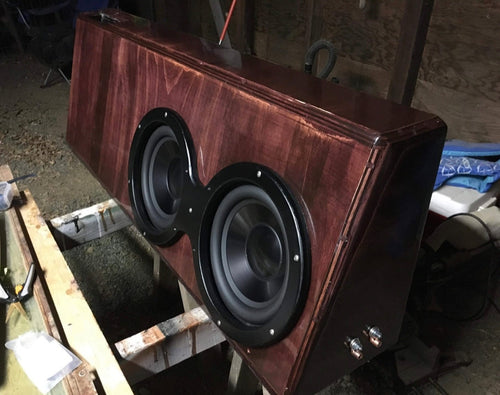
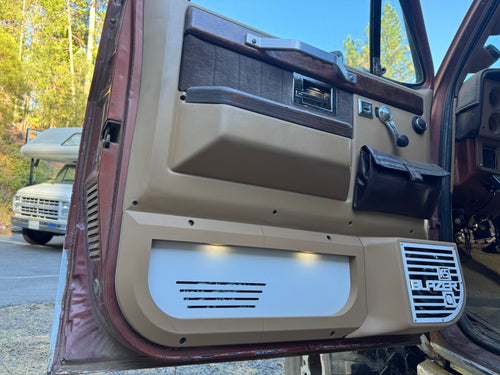
Interior fitment can be a little more forgiving in some areas, but it still is not something to assume. Door design, cab configuration, power options, speaker locations, trim, and previous cuts all matter. If you are upgrading audio, do not buy a universal solution just because the truck is called an R10 or V10. Measure what is there, inspect the door panels, and use parts built around the Squarebody cab whenever possible.
At Blazin' Biddles Off-Road, that is why we stay picky about fitment. These trucks deserve parts that work with the cab and the platform instead of forcing you to cut up good original panels to make something generic fit.
Which one is right for your build?
An R10 makes sense for a street truck, cruiser, lowered build, or clean daily driver. The two-wheel-drive layout is simpler, generally lighter up front, and gives you more straightforward options if your goal is a low stance and good road manners. That does not mean an R10 cannot work hard. Plenty of them have spent decades hauling tools, towing, and doing truck stuff.
A V10 is the better starting point if four-wheel drive is part of the plan. For snow, dirt roads, hunting property, fire roads, trail use, or a proper old-school 4x4 build, having the factory four-wheel-drive frame and drivetrain is worth a lot. Converting an R10 into a real V10-style four-wheel-drive truck is possible in the broad sense, but it is not a casual bolt-on project. By the time you gather the correct axle, springs, steering pieces, transfer case, transmission or adapters, driveshafts, mounts, and supporting parts, starting with a V10 is usually the smarter move.
There is no automatic winner. A clean R10 with solid floors, a straight cab, and honest maintenance can be a better buy than a rusty, hacked-up V10. Buy the condition and the intended use, then make sure the model code matches the parts list.
Check the truck before you trust the badge
Badges get replaced. Titles get entered wrong. Trucks get mixed together over 35-plus years of repairs and modifications. Before ordering anything major, confirm what you actually own.
Look underneath. An R10 should not have a front differential, transfer case, or front driveshaft. A V10 should have all three. Check the VIN and factory information when available, but also inspect the hardware on the truck. The truck itself is the final word.
If you are standing between an R10 and a V10, do not get hung up on the letter alone. Look for the truck that fits the build you want to drive, has the least amount of mystery underneath, and gives you a solid foundation to keep on the road or take off it.
Need The Parts For This Build?
We carry everything mentioned in this guide — picked and backed by real Squarebody owners.
0 Comments
Leave a Comment