
Best Squarebody Audio Wiring Kits for Clean Installs
A Squarebody can have a nice head unit, good speakers, and a strong amplifier, then still sound lousy because the wiring was treated like an afterthought. The best Squarebody audio wiring kits are not always the biggest box of wire on the shelf. They are the kits that match the system, protect the truck, and let you route everything cleanly without cutting corners or cutting up more of the cab than necessary.
These trucks are simple, which is part of why we like them. But many are also 35 to 50 years old. Factory wiring may have been repaired three times, hacked for an old cassette deck, or loaded up with questionable accessories. Before adding modern audio gear, you need a solid plan for power, ground, signal, and speakers.
What Makes the Best Squarebody Audio Wiring Kits?
There is no one kit that is right for every 1973-1991 Chevy or GMC truck. A basic two-speaker cruiser does not need the same wiring as a K10 with a subwoofer amp under the seat. The right kit depends on what you are installing, how much power it will actually draw, and how clean you want the finished truck to look.
A worthwhile kit starts with real copper wire, properly sized fuse protection, good terminals, and enough length to route wire the right way. That last part matters in a Squarebody. The battery may be up front, while your amplifier may live under a seat, behind a seat, in a console area, or in the cargo section of a Blazer, Jimmy, or Suburban. Buying a kit that is barely long enough usually turns into a bad ground location, a stretched power lead, or wire routed where it should not be.
For a clean install, think in four separate circuits:
- Main power and ground for an amplifier
- Speaker wire from the radio or amplifier to each speaker
- RCA signal cables and remote-turn-on wire for an amplified system
- A radio harness, adapter, or repair pigtail when the factory connector needs attention
Start With the System, Not the Kit
The easiest way to buy too much or too little wiring is to shop by amplifier size alone. Power ratings can be confusing, and peak numbers on a box do not tell you what the wiring needs. Use the amplifier's real fuse rating and the manufacturer's recommended wire size as your baseline.
For a smaller single-amp setup, a quality 8-gauge kit may be enough. A stronger system or a longer cable run may call for 4-gauge. Higher-draw multi-amp systems can need 1/0-gauge cable, a distribution block, and more attention to battery and charging-system health. Do not run oversized cable just to say you did, but do not undersize it because a kit was cheaper, either.
The ground wire deserves the same respect as the power wire. It should be the same gauge as the power lead, as short as practical, and attached to clean bare metal with solid hardware. Do not ground an amplifier to a rusty seat bracket, thin interior sheet metal, or a random screw. A weak ground can cause voltage drop, noise, heat, and intermittent problems that waste a lot of shop time later.
Fuse Protection Is Not Optional
The main fuse belongs close to the battery, generally within about 18 inches of the positive terminal. Its job is to protect the power wire if it gets damaged or shorted. It is not there to make the amplifier louder.
Use the correct fuse type and size for the wire and the system. If you need to run power wire through the firewall, use an existing protected pass-through where possible. If you must make a new opening, use a proper grommet. A bare wire rubbing through on firewall metal is the kind of problem nobody notices until it becomes a serious one.
Copper Quality Matters More Than Flashy Packaging
One of the biggest differences between wiring kits is conductor material. Oxygen-free copper, often called OFC, carries current better than copper-clad aluminum, commonly called CCA. CCA may look similar from the outside, but it has more resistance and is less forgiving in higher-current systems or long cable runs.
For a small, simple system, CCA can sometimes get the job done if wire size is increased appropriately. But for a Squarebody you plan to keep, especially one that sees summer heat, rough roads, or regular use, quality copper wire is the better move. It is easier to work with, handles current better, and gives you more room for future upgrades.
Also look past the gauge number printed on the insulation. Not every 4-gauge cable is truly the same size. Good cable has a flexible jacket, plenty of fine strands, and terminals that crimp securely. Cheap wire can be stiff, undersized, and frustrating to route behind old dash parts and interior trim.
Squarebody Routing: Keep It Serviceable
Squarebody cabs have room, but they do not have many modern hidden-wire channels. That means routing is where a clean build separates itself from a pile of wires under the carpet.
Run amplifier power wire down one side of the truck and RCA signal cables down the other when possible. This helps reduce the chance of alternator whine or other electrical noise getting into the audio signal. Speaker wire can usually follow either path, but keep it protected from sharp edges, moving seat tracks, pedals, parking-brake parts, and heat.
Do not run wiring loose under floor mats. Secure it with proper clamps, zip ties in sensible locations, or factory-style retention where available. Leave enough slack at the amplifier and behind the radio so components can be removed for service. Too much slack looks messy. No slack at all means the next repair requires cutting wire.
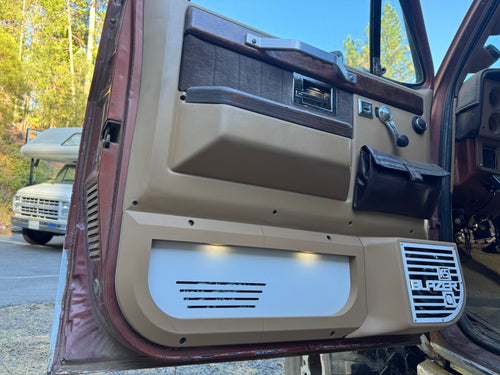
If you are installing lower door speakers, the door-jamb section needs extra thought. Speaker wire must flex every time the door opens. Use a protected boot or loom, avoid pinch points, and make sure the wire cannot rub against the window regulator or sharp inner-door metal. This is also why a no-cut, direct-fit speaker solution is worth considering when preserving original door panels matters to you.
Do Not Assume the Factory Radio Wiring Is Healthy
Many Squarebody trucks have factory radio wiring that is fine for a low-power head unit. Others have brittle insulation, missing connectors, old splices, or wires that have been repurposed over the years. Treat every old radio cavity like it has a story to tell.
Before connecting a new radio, verify constant power, switched power, ground, and speaker leads with a meter. Do not trust wire color alone, especially on a truck that has had previous stereo work. If the factory plug is damaged, repair it correctly or use an appropriate adapter rather than twisting wires together and wrapping them in tape.
A modern head unit should not be used to power a large set of speakers beyond what it is designed to handle. If you want more output from 6.5-inch door speakers, rear speakers, or a subwoofer, use an amplifier and wire it accordingly. That takes load off the radio and gives you more control over the system.
Match the Kit to How You Use the Truck
A show truck may justify hidden routing, labeled wiring, heat-shrinked terminals, and a finish that looks as good behind the panels as it does in the cab. A trail-driven K5 Blazer or work-used C20 needs the same basic quality, with extra focus on abrasion protection, secure mounting, and keeping equipment away from water and cargo damage.
For a daily-driven C10, a simple setup is often the smart one: a good radio, cleanly mounted speakers, adequate speaker wire, and maybe one properly wired compact amplifier. More equipment is not automatically better. A system that is sized right, tuned right, and installed cleanly will beat an overbuilt system with poor power and ground wiring every time.
If you are planning upgrades later, buy with that in mind. Running a slightly larger power wire now, leaving room for a distribution block, or adding an extra speaker-wire run while the interior is apart can save you from doing the job twice.
The Bottom Line on Squarebody Audio Wiring
The best Squarebody audio wiring kits are the ones built around your actual system, not a generic promise on a package. Use quality copper where current matters, fuse the main power lead close to the battery, make the ground short and solid, and protect every wire anywhere it crosses metal or moves with the truck.
At Blazin' Biddles Off-Road, we build around the idea that a Squarebody upgrade should solve a real problem without ruining what makes these trucks cool in the first place. Take your time with the wiring. Nobody will see most of it when the job is done, but you will hear the difference and appreciate it every time you turn the key.
Need The Parts For This Build?
We carry everything mentioned in this guide — picked and backed by real Squarebody owners.
0 Comments
Leave a Comment